

Showing posts with label 1951. Show all posts
Showing posts with label 1951. Show all posts
Wednesday, July 1, 2015


Monday, February 16, 2015

Thursday, September 25, 2014

Friday, August 29, 2014
The Lavender Hill Mob (1951) **

The Book refers to director Charles Crichton’s The Lavender Hill Mob (1951) as the funniest offering that London-based Ealing Studios ever produced. While there are sincere moments of hilarity in it, I must say that I much prefer both Kind Hearts and Coronets (1949) and The Ladykillers (1955) to this film. That’s not to say that it is subpar or unentertaining—there are a few laugh-out-loud moments and a rather dizzying scene at the Eiffel Tower that warrant notice, but there are still some shortcomings—most notably the inane car chase scene.

Some people don’t like British humor—I myself am not a fan of the likes of Benny Hill or Dr. Who, but for the most part I have a dry sense of humor. As such, the very British witticisms and quips that come out of Guinness’ and Holloway’s mouths in The Lavender Hill Mob are amusing. However, some of the best lines actually come from two ancillary characters: Miss Evesham (Edie Martin) and Mrs. Chalk (Marjorie Fielding).
Mrs. Chalk: But surely you must have some suspicion. Who work the heist rackets in this territory?
Policeman: Beg your pardon, lady?
Mrs. Chalk: Oh really! I can't make myself much plainer. Which hoodlums around here specialize in toby jobs?
And, there’s no denying that the plot is quite clever, too. The actual 

Wednesday, August 27, 2014
A Streetcar Named Desire (1951) ***

Anyone familiar with the mental health issues that plagued Vivien Leigh in the latter years of her life has to watch director Elia Kazan’s A Streetcar Named Desire (1951) with a sharper eye than those unaware of Leigh’s bi-polar disorder. It is rumored that near the end of her life that she would sometimes believe she was actually Blanche DuBois, so whenever I watch her Oscar-winning performance in this film I can’t help but try to see where the character begins and the actress ends. Watching Blanche’s descent into complete madness is, for me at least, like riding on a carousel that never stops spinning. This is an apt description, of course, because Blanche “hears” carousel organ music whenever she remembers the events that led to her husband’s death—and probably the pivotal incident that led to her slow de
A Streetcar Named Desire is based on the Tennessee Williams stage play of the same name. With the help of Oscar Saul, Williams adapted his Pulitzer Prize winning play to the screen with some edits. Obscenity, overt sexuality and rape, and Blanche’s husband’s homosexuality had to be glossed over (or altogether omitted) to get past the censors. While there are a few exterior scenes in the movie, for the most part the film is based in the Kowalski’s cramped and stifling New Orleans apartment. As such, there is a theatrical feel to the production, but unlike some other stage plays adapted to the screen that come off as artificial, A Streetcar Named Desire benefits from its production design. Kazan had the set walls designed to be movable so that the walls could progressively close in on Blanche as her madness took complete hold of her.

I’d be lying if I didn’t say the first few minutes of watching Blanche’s constant chattering as an affected Southern belle is both disconcerting and annoying. Each time I watch A Streetcar Named Desire it takes me a good 5-10 minutes to orient myself to her rambling and mannerisms—there’s a lot of crazy to absorb in a short amount of time. However, once you settle into her “cray cray” world you can’t help but be mesmerized by the inner-workings of her delusional mind. Leigh completely owns Blanche—as I stated above, it’s difficult to determine where the line between the actress and the role is drawn.
Of course, no performance, however stellar it may be, can stand alone. Leigh had the good fortune to work with three actors w
The fact that Brando lost the Oscar to Humphrey Bogart in The African Queen (1951) is irrelevant, because even though Leigh got top billing and appears in almost every scene of A Streetcar Named Desire, her performance still has the unfortunate fate of being relegated in the a
Overall, A Streetcar Named Desire is the beneficiary of four rather remarkable acting performances. And, even though some of the meatier sides of the original play were cut for censorship purposes, the story is so brutally told by Kazan that you can’t look away from the train wreck that is Blanche Du Bois’ life.
Sunday, July 6, 2014
An American in Paris (1951) **

Artistically director Vincent Minnelli’s An American in Paris (1951) is a triumph. It rightfully earned Oscars for its art direction (Cedric Gibbons, Preston Ames, Edwin B. Willis, and Keogh Gleason) and costume design (Orry-Kelly, Walter Plunkett, and Irene Sharaff), and I suppose one could make the case that its win for Best Music (Johnny Green and Saul Chaplin) wasn’t too far of a stretch—but one could definitely make a valid argument for Adolph Deutsch and Conrad Salinger’s work for Show Boat (1951), too. How
Jerry Mulligan (Kelly) is a struggling American painter who lives in the most pristine section of Montmartre ever depicted on film. Friends with a middle-aged child prodigy (Oscar Levant) and successful cabaret singer, Henri (Georges Guetary), Jerry is also “sponsored” by American heiress, Milo Roberts (Nina Foch). Obviously Nina has the hots for Jerry, but that
An American in Paris was inspired by George Gershwin’s music, most notably his 1928 orchestral composition of the same name. Several of Gershwin’s notable standards are performed: “Embraceable You “(from Girl Crazy, 1930); “Nice Work If You Can Get It” (from A Damsel in Distress, 1937); “Our Love I
Gene Kelly could dance, there’s no doubt about it, but how many of the same tap routines must one watch in the same movie? And, then there are the ballet sequences. I can get over that Kelly and Minnelli chose to introduce their big discovery, Caron, in a hodgepodge ballet number—at this time, she was a ballerina and not an actress. Moreover, I can somewhat stomach their interpretive dance along the Seine for “Our Love Is Here to Stay”. 
So, I know I’m probably in the minority regarding my distaste for An American in Paris. Frankly, I don’t care. The story is lackluster. The acting is passable but by no means stellar. The most memorable musical number is a ballet sequence that has no connection to the plot narrative. Seventeen minutes of spectacular art direction and costume design, and beautiful choreography does not make a film great—especially when the other 96 minutes are only mildly entertaining.
Wednesday, April 18, 2012
The African Queen (1951) ***

Something happened to Katharine Hepburn in the 1950s that was both a blessing and a curse: she started playing a lot of spinsters. Some of these spinsters were painful to watch (think The Rainmaker and Summertime), but thankfully her turn as Rose Sayer in The African Queen (1951) was the perfect vehicle for her maturing talents. She had adept screenwriters (James Agee and John Huston); an accomplished director (John Huston); an award-winning cinematographer (Jack Cardiff); and, an age-appropriate co-star (Humphrey Bograt)—all of these essential elements allowed Hepburn to turn Rose into the best spinster portrayal of her storied career.
Based on C.S. Forester’s 1935 novel The African Queen, 
Most people who have read Forester’s novel will tell you that the movie is ten times better. This is not to say that screenwriters Agee and Huston changed a lot when they 
Charlie: A man takes a drop too much once in a while, it's only human nature.
Rose: Nature, Mr. Allnut, is what we are put in this world to rise above.
The characters’ words never seem forced and they always sound appropriate. I wish more screenwriters wrote dialogue like this.
John Huston also received an Oscar nomination for his direction of the film. While he and Bogart were cut from the same cloth, dealing with Hepburn in the middle of the jungle could have been a nightmare if he hadn’t approached her in the right way. He obviously was successful in this endeavor because Hepburn later 
Besides the off-beat love story, what is most remembered about the movie is its cinematography. Can you really shoot a film in the middle of the African jungle in anything other than Tech
Finally, what I think makes this Hepburn’s best spinster role is that her co-star is Bogart. Slightly seven years older than Hepburn, Bogart looked like the kind of man who could fall for an aging old maid. Rough and grizzled, Bogart had the necessary pr
Tuesday, February 22, 2011
Strangers on a Train (1951) ***

(This article is from guest contributor The Lady Eve and first appeared at http://classic-film-tv.blogspot.com/. The rating in the title is my own.)
It was the middle of the 20th Century and Alfred Hitchcock's last major film had been Notorious (1946). Four years and four films later, he was in a slump.
 Though The Paradine Case, Rope, Under Capricorn and Stage Fright were all interesting attempts, each one had its problems and each had bombed.
For his next project, Hitchcock looked to the first novel of young Patricia Highsmith. Intrigued by its clever "criss-cross" murder plot, he bought the rights to Strangers on a Train.
Raymond Chandler was tapped to tackle the screenplay, though Czenzi Ormonde, a protégé of Ben Hecht, rewrote most of it. Cinematographer Robert Burks collaborated with Hitchcock for the first time and earned an Oscar nomination for his efforts. He was nominated again for Rear Window and won for To Catch a Thief. Dimiti Tiomkin, who had last worked with the director on Shadow of a Doubt, composed the film's nimble score. Hitchcock produced and directed for Warner Brothers.
 A thriller of mature scope and depth, Strangers on a Train (1951) is also considered one of Hitchcock's most accessible films; its overwhelming success revived the director's reputation at a crucial point. It also signaled the beginning of his final great filmmaking period.
Strangers on a Train is pure and classic Hitchcock. It begins as two young men meet very cute in the first class club car of a commuter train. One is a tennis celebrity, the other a wealthy ne'er-do-well, and what seems like casual chit-chat has deadly consequences. A study in Alfred Hitchcock's mastery of visual storytelling and technical wizardry, the film bears all the hallmarks of his style...
 There are spectacular visual set pieces, among them...1) Bruno stalks Miriam at a fairgrounds and, in a stunning shot, strangles her on a secluded island, 2) Guy makes a stealthy visit to Bruno's darkened home where a large growling dog adds even more suspense, 3) An intense tennis match is cross cut with scenes of Bruno's harrowing journey to plant evidence, 4) a carousel disaster comes to a breathtaking climax.
Prominent historical sites appear; Washington, D.C., landmarks are woven into the scenario with the Jefferson Memorial in a stark cameo.
There is an "innocent man accused" theme and a powerful doppelganger motif.
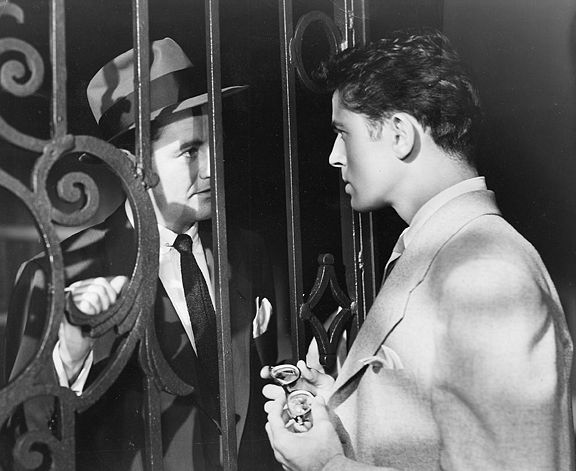 Though there are no marquee names, the cast is solid. Farley Granger fleshes out handsome, guileless and beleaguered tennis star Guy Haines; Laura Elliott (Kasey Rogers) is delicious as his estranged wife, Miriam; Marion Lorne stands out as Bruno's discombobulated mother. Leo G. Carroll is credibly senatorial as a U.S. Senator and Patricia Hitchcock gives one of her best performances as his quirky younger daughter.
Alfred Hitchcock once told Francoise Truffaut, "...the more successful the villain, the more successful the picture. That's a cardinal rule..." The bold, unforgettable performance of Robert Walker as psychopathic Bruno Anthony is proof positive of that rule. Remarkably, Walker had mostly been cast as male ingénues up to then.
 Like Joseph Cotten's Uncle Charley in Shadow of a Doubt, Walker's Bruno is a glib, self-possessed charmer - who is also a remorseless killer. Walker is riveting onscreen. His Bruno is confident, slick, erratic...and very, very creepy. His smooth veneer barely masks a simmering rage. With a voice that ranges from sensual as velvet to cold and hollow as tin, his eyes glitter, glare, caress.
From the moment Bruno is first seen in the club car insinuating himself into Guy's life, to his final seconds of life, when he mercilessly implicates Guy with his dying breath, Walker dominates and energizes the film. Pat Hitchcock once observed that for all her father's genius, it was Walker's daring performance that 'made' the picture.
 Walker died tragically at age 32 less than two months after the film was released. He had appeared in more than 30 films in his career, but it was only Strangers on a Train that allowed him to unleash the devastating range of his talent. Farley Granger later reflected, "he was great in the film; his potential was limitless, his career was just beginning to take wing."
 Robert Walker's life had been short and often troubled, and his early death sent shock waves through Hollywood. In time, though, it became clear that he had a bit of good fortune after all; his greatest role, his single virtuoso performance, was preserved within one of Alfred Hitchcock's finest films.
British film critic and historian David Thomson noted in a piece on Strangers in 1999, Hitchcock's centennial year, that Walker's was "...a landmark performance. You see it now and you feel the vibrancy of the modernity...he had had that one chance..."
Saturday, February 12, 2011
The Day the Earth Stood Still (1951) ***

(This article is from guest contributor Rick29 and first appeared at http://classic-film-tv.blogspot.com/. The rating in the title is my own.)
If there were a Hall of Fame for Timeless Movies, then one of its founding members would be The Day the Earth Stood Still. I've probably watched it at least once every decade since I first saw it on NBC's Saturday Night at the Movies in the 1960s. When I was a youngster, the film's fantastic elements--and Gort, the coolest robot on celluloid--appealed to me. When I was a teen, its stern warning about the perils of nuclear war resonated with me. With each subsequent viewing, The Day the Earth Stood Still has revealed something new: presenting itself as a Biblical analogy, an editorial on the influence of media on public opinion, a portrait of fear of the unknown, etc.


The success of The Day the Earth Stood Still hinges, in large part, on the casting of Klaatu. Producer Julian Blaustein and director Robert Wise originally considered Claude Rains, but his stage schedule made him unavailable. 20th Century-Fox head Darryl F. Zanuck suggested Spencer Tracy, but Blaustein worried that a well-known star would be a distraction (interestingly, that concern didn't apply to Rains). It was Zanuck who eventually "discovered" Michael Rennie, who was peforming in the British theatre. The tall, low-key Rennie brought conviction to the role, but his greatest accomplishment was making the alien visitor seem human. This is no small feat, as evidenced by a scene in which Klaatu reads the words of Lincoln and wants to meet him. This sequence could easily have come across as hokey, but Rennie makes it quietly effective and even heartfelt (since Klaatu has finally found someone who gives him hope about the human race).

With a human-like alien, it was left to the robot Gort to bring an eerie, other-worldly quality to the film. To make the robot as physically imposing as possible, the producers hired Lock Martin, a 7' 7" doorman at Grauman's Chinese Theater. To make Gort even taller, Martin wore 4-6" platform shoes. Walking in the heavy rubber suit in high heels was physically exhausting. There were two suits, one that laced on the front and the other in back. Martin changed suits depending on the camera angle, so that it looked like Gort had no "seams." In some shots, a static model of the robot was used. That Gort model was later bought by Larry Harmon, overhauled so it didn't look much like Gort, and used in Harmon's Bozo the Clown television show.

In addition to its visual impact, The Day the Earth Still even sounds other-worldly thanks to composer Bernard Herrmann's innovative use of a theremin (shown on right). One of the first electronic instruments, the theremin is "played" by moving one's hands in front of it to change sound frequencies. Its distinctive sound became almost a cliche through repeated use in other sci fi films of the 1950s. Still, Herrmann' score remains an impressive achievement today.
Loosely based on the Harry Bates story "Farewell to the Master," The Day the Earth Stood Still features strong religious undercurrents. Klaatu becomes a Carpenter (if in name only). He performs a "miracle" of global proportions. He brings a message of peace, but is largely misunderstood. And, of course, he is murdered and resurrected. Producer Blaustein credits screenwriter Edmund H. North for adding these provocative layers on top of a traditional science fiction tale.
The cast, music, and richness of themes contribute mightily to the film's timeless quality. But it's the story--along with that awesome robot Gort--that makes The Day the Earth Stood Still popular with viewers of all ages. I love to watch it with young people and tell them that they will need to memorize the film's classic phrase and repeat it at the appropriate point in the film...or the Earth will be destroyed. You'd be amazed at how many different variations I've heard of: "Klaatu barada nikto!"
Subscribe to:
Posts (Atom)