Showing posts with label ***. Show all posts

Friday, May 8, 2015

Les vampires (1915) ***

lesVposter
First, don't allow the title of this 1915 French silent serial to fool you--this is not a film about blood-sucking vampires. Sorry to disappoint the Goths and Ann Rice fans. Yet, take solace, the villains do wear a lot of black and seem to like to wear a lot of face powder. Second, don't attempt to watch all 10 episodes (approximately 7.5 hours) in one sitting. After heeding these few bits of advice, sit back and prepare yourself for the strange mind of Louis Feuillade.

The story revolves around a Parisian criminal gang who refer to themselves as, you guessed it, the Vampires. Their arch-nemesis is a news reporter named Philippe Guerande; a man I would not refer to as compelling. And like any good hero, he has a bumbling sidekick named Mazamette. The clear svampire01tar of the film is Musidora, who plays Irma Vep, one of the more capable Vampires.

This film has a number of twists and turns--you never really know who is good and who is evil. And even when you get a good impression of who actually is a baddie, say the Grand Vampire for example, they end up killed and replaced by another Grand Vampire, who, in turn, also ends up dead as well. All told, there were 4 Grand Vampires. In addition, seemingly upstanding citizens, such as judges and cops, turn out to be members of this society of criminals.

The film is a showcase of criminal possibilities--robberies, shootings, poisonings, trap doors, scam artists...the list goes on and on.

This crime thriller is an interesting watch. Later films in this genre owe a lot to Feuillade. But be warned, you must have patience to enjoy this film. There are some episodes that could have done with a bit more editing--not Baz Luhrmann cuts exactly but something closer to Hitchcock. In the realm of film history, this film serves its purpose.

Release date of Part 1: November 12, 1915.


Thursday, December 4, 2014

It’s a Wonderful Life (1946) ***

Its-A-Wonderful-Life-its-a-wonderful-life-1237475_1329_1920

It is a myth that the suicide rate increases between Thanksgiving and Christmas.  However, the “most wonderful time of the year” is not always so wonderful for everyone.  Christmas cards, crowded stores, wrapping presents, and mounting debt can weigh heavily on the psyche. And, then there are those who have lost loved ones or feel as though they haven’t any loved ones at all.  For these people, the holiday season is a torturous time, full of regrets and sorrows.  What-ifs, should-haves, and if-onlys play cruel tricks on those who carry around ghosts and faded dreams in their troubled minds.  I suspect this is the reason that It’s a Wonderful Life (1946) has endured as a Christmas tradits-a-wonderful-life-failureition for more than fifty years. Everyone—yes, everyone—has a little of George Bailey running around in their subconscious.  As a wise person once told me, circumstance touches everyone—no one is immune.

I enjoy watching It’s a Wonderful Life every Christmas season because I can relate to George Bailey (James Stewart). An adventurer at heart but a duty-bound person in reality, George and I both made life-altering decisions based on the cards circumstance dealt us—even if that deck was full of jokers we played the game by the rule of responsibility; I expect many others can say the same.

For those unfamiliar with George’s story, it is a simple one. From a very young age George exceeded expectation: he saved his brother (Todd Karns) from drowning and prevented his drunken pharmacist boss (H.B. Warner) from accidentally poisoning someone. When his father (Samuel S. Hinds) died of a stroke he forwent a trip to Europe and then college to head the family’s struggling building and loan company. Instead of spending $2,000 on his tumblr_mbucxk8NL61qfoua5o1_250honeymoon he used it to stave off a run on the bank.  He invested in a town, Bedford Falls, and a group of people that at heart he wanted nothing more to do than to escape.  Along the way he married a girl (Donna Reed) he knew worshipped him, and agreed to live in a ramshackle house filled with children that required he continue in a job he hated in a town too small for his ambition. And then a bit of ironic circumstance slapped poor George in the face: his undoing was to come at the hands of his own obedience to duty and responsibility.  This, no doubt, was the last bitter pill that George could allow himself to swallow, and so he took it believing that at least he did what was best for others.  Ah, but what would have life been like for all those who benefitted from George’s benevolence and self-sacrifice if he had never existed?  It takes an angel (Henry Travers) seeking his wings to show George that what he viewed as a failed existence was of significant importance to so many others.  

In the end, It’s a Wonderful Life, is a redemption tale. Upon release some critics found the movie too sentimental and said that it idealized an unrealistic world.  By this time just about any film from director Frank Capra was labeled as overly-YCURTIS_P1.jpg_full_380sentimental by many critics (perhaps you are familiar with the term “Capra-corn”?), and so many overlooked the universal theme of circumstance—it touches everyone.  And, so this corny film that lost $525,000 in 1946, now draws millions of viewers every Christmas. I’ve heard many people say that they watch it to remind themselves that perhaps they didn’t live the life they wanted, but at least they lived the life they got.  They, like George Bailey (and myself), endure the circumstances of life. Perhaps you are not a religious person—you are the perfect candidate for this film which Capra made to combat atheism—but there is one particular Bible verse that applies to this movie. It is written in James 5:11 that “we count them happy which endure”.  Happily, the spirit of It’s a Wonderful Life continues to endure today. 

Friday, September 5, 2014

Shane (1953) ***

11588

There are memorable endings, and then there are truly memorable endings—director George Stevens’ Shane (1953) resides in the latter category.  Once you’ve seen it, you will never forget it. It takes a lot for a movie to even make me sniffle, let alone out-and-out cry, but Shane’s hauntingly bittersweet conclusion, even after numerous viewings, always makes me weep like a baby.  Perhaps it evokes my own personal understanding of how heartbreaking childhood loss can be. Whatever may be the case, Shane is one of my favorite westerns of all time—and I don’t even really like the genre.

Based on the Jack Schaefer 1949 novel of the same name, Shane is about the struggle between a group of Wyoming Homesteaders and a rancher named Rufus Ryker (Emile Meyer) and1sk0lj his ranch hands.  Ryker resents the Homesteaders for fencing in his grazing land and cutting his herd off from water. The Homesteaders live in fear of acts of retribution by Ryker’s men.  One family, the Starretts, are of particularly annoyance to Ryker because the head of the Starrett family, Joe (Van Heflin), is a strong-willed man who encourages the other Homesteaders to carry on in the face of Ryker’s intimidation.  As if Joe wasn’t a big enough thorn in Ryker’s side, Joe hires a stoic drifter named Shane (Alan Ladd) to help him around the farm. While it’s never said, it’s obvious that Shane is an adept gunfighter who is trying to escape his past.  The Starretts take him into their family, and their son, Joey (Brandon deWilde), gets one of the worst (and cutest) cases of hero-worship known to childhood.  The mother, Marian (Jean Arthur), also develops a quiet, innocent crush on Shane, too.  When Ryker realizes he’s up against two men, Joe and Shane, who won’t be easily pushed around, he sends for a gunfighter in Cheyenne, named Wilson (Jack Palance), to solve his problems.  What ensues is cold-blooded murder and one of the most iconic showdowns in all of cinema.

lhomme-des-vallc3a9es-perduesThere are many things to admire about Shane.  A.B. Guthrie and Jack Sher’s screenplay does a good job of fleshing out the characters and their motivations, and expertly explains, with a well-constructed dialogue exchange between Ryker and Joe, why ranchers so dislike Homesteaders.  Still, even though the scene in question somewhat humanizes Ryker, the rest of the film does its best to demonize him. The character who is most explained, of course, is Shane.  His conversations with both Joey and Marian about guns explains a lot about how Shane sees the world and himself.  Yet, while the audience gets a clear view of Shane’s motivations, the character of Wilson is pretty one-dimensional.  This is not to say that he isn’t interesting or that Palance didn’t deserve his Best Supporting Actor Oscar nomination, because Palance created one of the meanest (and most memorable) bad guys in film with Wilson.  Dressed in all black and wearing an eerily frozen psychotic grin on his face, Wilson is the personification of evil. 

Shane was expertly shot on location near Jackson Hole, Wyoming, surrounded by the Grand Teton Mountains.  Loyal Griggs won an Academy Award for capturing both the picturesque backdroshane-alan-ladd-gunps of the vast plains surrounded by the mountains, as well as how well he depicted director Stevens’ vision of the final few scenes of the movie, which are comprised of the looming and eventual showdown between Shane and Wilson. The silhouetted images of Shane riding through the night to Grafton’s saloon/store to meet Wilson, with little Joey running behind, creates a feeling of anticipation and dread.  And, then there’s Shane’s entrance. With slow, long loping steps Shane walks across the wooden floorboards of Grafton’s and glides through the swinging bar doors to meet his destiny—only Gary Cooper’s determined walk down the streets of Hadleyville in High Noon (1952) rivals this as the most bad-ass entrance into danger ever. 

shaneOf course, what most people remember about Shane (besides how evil Wilson was) is the ending. Throughout the film little Joey has become more and more attached to Shane—so much so that it is heartbreaking to watch as he calls after his hero, “Shane! Come back!”  There are several interpretations of what this scene means. Was Shane mortally wounded and riding off into the vast unknown of mortality?  Was he going to return to his gunfighting ways, as exhibited by his comments to Joey that, “A man has to be what he is, Joey. Can't break the mould. I tried it and it didn't work for me” ?  Did he leave because he’d grown too attached to both Joey and Marian?  Who knows, and who cares—just enjoy his quiet ride into the…well, it wasn’t a sunset (more like a purple set), but you get the point.

Alan Ladd, by all accounts, was one of the nicest men in Hollywood, so he obviously didn’t have to put on an act to make Shane so amenable, but that doesn’t negate how effortlessly he playsx his role.  And while he benefitted from working with an extremely talented cast, it’s never easy working with children.  Yet, somehow his scenes with the doe-eyed Brandon deWilde (who was also nominated for Best Supporting Actor) play very naturally—and sound like conversations you might here between a father and son—nothing appears forced.  Jean Arthur also had the same chemistry with deWilde that Ladd did.  I can’t imagine how Katharine Hepburn, Stevens first choice for the role of Marian, could have ever brought the needed gentleness to the scenes between Marian and Joey.  This was Arthur’s last film role (she actually came out of retirement to do it), and she certainly went out on a high note (unlike poor Hepburn who ended her film career playing Warren Beatty’s aunt in his horrible remake of Love Affair). 

Overall, Shane is an iconic western.  It benefits from good acting and stellar cinematography—and perhaps one of the greatest endings in cinematic history.

Wednesday, August 27, 2014

A Streetcar Named Desire (1951) ***

A-Streetcar-Named-Desire-1951-6-sheet

Anyone familiar with the mental health issues that plagued Vivien Leigh in the latter years of her life has to watch director Elia Kazan’s A Streetcar Named Desire (1951) with a sharper eye than those unaware of Leigh’s bi-polar disorder.  It is rumored that near the end of her life that she would sometimes believe she was actually Blanche DuBois, so whenever I watch her Oscar-winning performance in this film I can’t help but try to see where the character begins and the actress ends.  Watching Blanche’s descent into complete madness is, for me at least, like riding on a carousel that never stops spinning.  This is an apt description, of course, because Blanche “hears” carousel organ music whenever she remembers the events that led to her husband’s death—and probably the pivotal incident that led to her slow deA-Streetcar-Named-Desire-1951-e1333288250105cline toward insanity.  There is an overall atmosphere of depravity and desperation to this movie, and, as such, it is a dark and heavy film which requires the full attention of the viewer—you can’t look away, no matter how brutal things get.

A Streetcar Named Desire is based on the Tennessee Williams stage play of the same name.  With the help of Oscar Saul, Williams adapted his Pulitzer Prize winning play to the screen with some edits.  Obscenity, overt sexuality and rape, and Blanche’s husband’s homosexuality had to be glossed over (or altogether omitted) to get past the censors. While there are a few exterior scenes in the movie, for the most part the film is based in the Kowalski’s cramped and stifling New Orleans apartment.  As such, there is a theatrical feel to the production, but unlike some other stage plays adapted to the screen that come off as artificial, A Streetcar Named Desire benefits from its production design.  Kazan had the set walls designed to be movable so that the walls could progressively close in on Blanche as her madness took complete hold of her. viv51

I’d be lying if I didn’t say the first few minutes of watching Blanche’s constant chattering as an affected Southern belle is both disconcerting and annoying.  Each time I watch A Streetcar Named Desire it takes me a good 5-10 minutes to orient myself to her rambling and mannerisms—there’s a lot of crazy to absorb in a short amount of time.  However, once you settle into her “cray cray” world you can’t help but be mesmerized by the inner-workings of her delusional mind.  Leigh completely owns Blanche—as I stated above, it’s difficult to determine where the line between the actress and the role is drawn. 

Of course, no performance, however stellar it may be, can stand alone.  Leigh had the good fortune to work with three actors wA_Streetcar_Named_Desire_(1951)_4ho knew their own characters inside and out, as Marlon Brando, Kim Hunter, and Karl Malden had also starred in the heralded original Broadway production of the play.  Jessica Tandy had played Blanche in that production, but Leigh, who had starred as Blanche in the London stage production, was deemed a much better box office draw than Tandy. As a result of this, Leigh felt like an outsider working with a cast who’d worked so closely with one another—and all of whom were members of Kazan’s Actors’ Studio.  With a completely different style of acting than her co-workers, Leigh was encouraged to use her “outsider” status to build on Blanche’s own personal isolation.  It must have worked, because all of the principal actors were nominated for Oscars--Leigh won Best Actress; Hunter won Best Supporting Actress; Malden won Best Supporting Actor; and, Brando was nominated as Best Actor. 

The fact that Brando lost the Oscar to Humphrey Bogart in The African Queen (1951) is irrelevant, because even though Leigh got top billing and appears in almost every scene of A Streetcar Named Desire, her performance still has the unfortunate fate of being relegated in the aAnnex - Brando, Marlon (A Streetcar Named Desire)_NRFPT_02nnals of cinema history to that of Brando’s. In only his second film role, Brando exudes raw sexual magnetism as Stanley Kowalski.  Few actors can play a brutal and cruel man and still come off as a desirable character, but Brando had such an understanding of the dynamics of his character that he developed one of cinema’s greatest anti-heroes in Stanley.  And, of course, who can ever forget his bellowing of “Stell-ahhhh!”?

Overall, A Streetcar Named Desire is the beneficiary of four rather remarkable acting performances.  And, even though some of the meatier sides of the original play were cut for censorship purposes, the story is so brutally told by Kazan that you can’t look away from the train wreck that is Blanche Du Bois’ life. 

Monday, August 25, 2014

The Treasure of the Sierra Madre (1948) ***

the-treasure-of-the-sierra-madre

Director John Huston and his father, Walter, showed Hollywood what greed looked like when they took home three Oscars in 1948 for their work in The Treasure of the Sierra Madre (1948).  This was fitting, of course, because greed for gold was what the film was about.  However, I am happy to report that no one had to be shot or macheted for the Huston’s to cash in on all their hard work.

sjff_01_img0503John took home the Oscar for Best Director and earned another one for his adapted screenplay of B. Traven’s 1927 novel of the same name.  Traven, by all accounts, was a bit wacky but probably deserved a share of Huston’s screenplay award because, for the most part, Huston’s script followed the book quite closely.  The story is taut with tension and paranoia and is an excellent study of what greed can do to otherwise decent people. While the corrupting influence of greed was nothing new to cinema—most notably, Erich von Stroheim made his notorious nine-hour film, Greed (1924), about it—The Treasure of the Sierra Madre did it in such a direct and concise manner that it is probably the best film ever made on the subject of the depravity of greed. 

The story takes place in 1920s Mexico, where three down on their luck Americans meet in a flop house and discuss prospecting for gold.  Old timer Howard (Walter Huston) tells Dobbs (Humphrey Bogart) and Curtin (Tim Holt) that he knows of a place where they might find a payload of goltreasure-of-sierra-madre-5d—the Sierra Madre Mountains. After pooling their money and buying mules and tools, they set off through the rugged terrain in search of gold. Along the way they must fend off outsiders, bandits, and, finally, one another.  From the outset it’s pretty obvious which of the men is the most susceptible to greed—his paranoia drives him over the edge and eventually leads to his ruination.  Though not recognized by the Academy for his menacing performance, Bogart probably turned in the acting job of his life as a man so consumed with paranoia and greed that by the end of the movie his character is almost totally transformed.

madre3Huston, however, was recognized by the Academy and was awarded a Best Supporting Actor Oscar for his last great screen role. He’d been nominated three previous times, but it was his eccentric, folksy performance as the moral center of this film that finally won him an Oscar.  Anyone who’s seen the movie knows that when we first meet his Howard he seems rather untrustworthy and the most likely to turn on his prospecting partners, but as the story progresses his little nuggets of wisdom about the shortcomings of a man’s soul/character sets him up almost as an oracle from Greek mythology. 

The Roman philosopher Seneca once wrote that “For greed all nature is too little”, and The Treasure of the Sierra Madre does an excellent job of proving him correct. One thing that sets the movie apart is the fact that John Huston insisted motreasure-of-the-sierra-madre-1948-bogart-gold-hatst of it be shot on location in Tampico and Durango, Mexico. This added an element of authenticity to the production, and also incorporated another character to the movie: nature.  The scenes where the men are trudging through the mountainside with the sun beating down on them and dust is flying contributes to the declining psyches of the men.  The gritty realism of these scenes makes it almost understandable than a man could be pushed beyond all morality.

Overall, The Treasure of the Sierra Madre is a tight morality tale about the dangers of greed.  It is filled with great performances and an atmosphere of realism. 

Sunday, June 29, 2014

Three Colors: Red (Trois couleurs: Rouge) *** 1994

three-colors-red-poster

The third installment in director Krzysztof Kieslowski’s Three Colors Trilogy, Red (1994), is by far the most philosophical and entertaining of the group.  I am a fan of films that interconnect the seemingly unconnected—this is why I so adore directors/producers like Alejandro Gonzalez Inarritu and Alfonso Cuaron—and Three Colors: Red not only artfully pulls together what appears to be two independent stories but also seamlessly unites all three movies of the trilogy together in one fell swoop. Kieslowski was justly rewarded Oscar nominations for Best Director and Best Original Screenplay (along with co-writer Krzysztof Piesiewicz) for his cinematic interpretation of the bonds of fraternity.  How on earth this wasn’t one of the five nominees for Best Foreign Language Film is beyond comprehension (although if it had been nominated it wouldn’t have won, as even the film that should have won, Before the Rain, was somehow beaten by Burnt by the Sun—personally, I believe that international politics had a lot to do with this outcome…oh, stroiscouleursrouge1994ttop, this is not what this review is about…). Thankfully, the Academy did nominate Piotr Sobocinski for his brilliant cinematography, which only elevates the complexity of this intricately woven together story.

Perhaps it is a coincidence that Red takes place in Geneva, Switzerland, but I like to believe Kieslowski chose this setting because of the Geneva Convention, which established the standards for the humanitarian treatment of war.  No, this isn’t a movie about war, but it is, in some way at least, about how laws and society determine what is ethically and socially acceptable.  As in the first two films of the trilogy, Red abounds with isolated, lonely characters.  Valentine (Irene Jacob), a student, model, and pleasant and innately good person, is separated from her family and her pathologically jealous boyfriend. However, quite by accident, her world is changed by running over the dog of retired Judge Kern (Jean-Louis Trintignant). When she returns the dog to him, Kern seems not to care and she takes on the responsibility of nursing the dog back to health. When the dog runs away, Valentine returns to Kern’s house on the off chance that’s where the dog has gone. It also gives her a reason to return the excess amount of money that Kern sent to her to pay the dog’s vet bill. Of course, Kern knew that she Trois couleurs - Rouge1would do this, because he understands that she is driven by her interpretation of what is right and what is wrong. Upon this visit, she learns the Kern eavesdrops on all of his neighbor’s phone conversations. She is repulsed by not only his actions but also by how he views the world. When she threatens to turn him in, Kern says that it will make little difference if she does, because in the end all of his neighbors’ (and perhaps society) lives will eventually turn into hell anyway.  She doesn’t turn him in, but she does cry for him—and she leaves the dog with him, too. Obviously Valentine has an impact of Kern, because he writes confessional letters to all of his neighbors who then proceed to bring civil action against him.  Upon reading about the case, Valentine returns to Kern’s to swear that she didn’t turn him in and learns that it was Kern himself who did so.  And, thus, one very unlikely friendship develops. 

The twist to the plot is that there is a parallel story that runs throughout the movie that only starts to come together after Kern explains to Valentine (in an absolutely inspired setting: a dark red theater with red chairs) how he came to be such a wretched man.  Like Auguste (Jean-Pierre Lorit), a young man studying for a judgeship (and the man who lives across the street from Valentine), Kern had dropped a jurisprudence book that when picked up was opened to a chapter which provided the answer to the most crucial question of the exam. And, as Auguste is deeply in love with a woman who betrays him (Frederique Feder), so was Kern.  He was so desperately in love with her that he followed her across the English Channel but she died in an accident.  Strangely enough, Auguste will follow his woman across the English Channel, too, but Valentine will also be on the ferry crossing.  When a disastrous storm strikes, only current_redfgseven people survive: six of them look quite familiar to anyone who has seen the entire trilogy.

Red, of course, is the dominate color. It’s in every shot, either as an object, as a background, or as a lighting element.  As mentioned above, perhaps the most striking use of the color is the set design of the theater. For me, Kern’s description of the events that destroyed his faith in man and in himself is deeply personal. He allows Valentine to see inside him—his metaphorical flesh--which is symbolically enveloped by the sea of red which encompasses the entire theater. 

hero_EB20030309REVIEWS08303090308ARThe second most memorable use of the color red is almost shockingly clever.  Early in the movie, Valentine does a photo shoot for a billboard ad for chewing gum.  In the scene, the photographer instructs her to stand in profile and think of the saddest thing she can think of.  The backdrop of the photograph is an endless swath of red.  Up goes the billboard and occasionally it makes an200_s appearance when Auguste or Kern notice it, but it seems to hold no larger meaning.  That is, of course, until the end of the film, when Valentine is rescued from the ferry and news cameras catch a extremely sad looking Valentine’s profile in a backdrop of, you guessed it, red. 

Obviously, I have droned on enough about why I prefer Red’s story arc to that of its trilogy mates, Blue (1993) and White (1994), but plot is not the only superior quality that Red has. Unequivocally, Red is the best acted of the three films. I‘m not trying to take anything away from Juliette Binoche’s turn in Blue, because she gives a haunting performance, but she didn’t have the luxury of working opposite Jean-Louis Trintignant.  Unfortunately, American audiences, in general, have no idea who Irene Jacob is.  Very early in her career she made two very important movies, Au revoir, les enfants (1987) and The Double Life of Veronique (1991), as well as Red, that found her poised for international stardom, eGUxYXYwMTI_o_kieslowski-trois-couleurs-rouge-1994-extrait3but after a number of lackluster movies her film career pretty much evaporated, sans a few minor roles in a number of crappy productions.  This is a shame because in Red she gives a multi-layered performance that shows her ability to display emotional depth. Additionally, she is not overshadowed or overwhelmed by working opposite one of the greatest French cinematic actors ever, Jean-Louis Trintignant.  Unlike Binoche, who absolutely dominates every scene she is in with Benoit Regent, Jacob is evenly matched with Trintignant.  Their conversations about what is ethically and socially acceptable are so well done that the viewer feels as if they are the one eavesdropping on the private conversation of one of their own neighbors.

Overall, Red benefits from gorgeous cinematography, good acting, and a tightly-woven intricate story. If I were to levy a complaint about it, it would be that the idiotic phone conversations between Valentine and Michel (the jealous boyfriend) could have been cut without much notice. 

Friday, June 20, 2014

Giant (1956) ***

m5ekyljtzVQmBySwqcNWGAwgaHq

Giant (1956)—was there ever a more appropriately named Hollywood production?  And, I’m not just referring to its three hour and twenty-one minute runtime, either. Director George Stevens rightly earned his second Academy Award for Best Director by capturing the vast landscape and racial complexity of Texas, while coaxing out tremendous performances from his cast. 
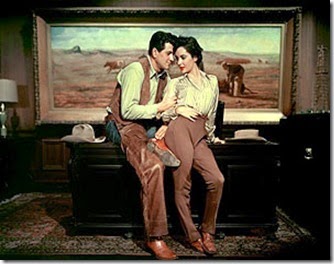
giant_2Edna Ferber wrote novels and plays that Hollywood liked to turn into movies: So Big (1924, 1932, and 1953), Show Boat (1932, 1936 and 1951), Cimarron (1931 and 1960), Saratoga Trunk (1945), Stage Door (1937), Dinner at Eight (1933), and The Royal Family of Broadway (1930)—to name a few, although there are others. Published in 1952, Giant was Ferber’s tenth novel. Her critique of Texas race relations in the book scandalized the Lone Star state and caused quite a stir in the literary world. As controversy was good for the box office, just about every studio in Hollywood wanted to buy the rights to it, but only George Stevens made her an offer she couldn’t refuse: he made her a producer and promised to make a faithful film adaption of her novel. As it turns out, he made as faithful an adaption as he and Warner Brothers were willing to make.  Specifically, sections of the novel that dealt with African Americans and Jim Crow were cut altogether or amalgamated into the film’s discussion of racism against Mexican Americas.  Still, Fred Guiol and Ivan Moffat’s Oscar-nominated adapted screenplay was groundbreaking not only in its treatment of racism but also in its portrayal of class and gender issues.  The story, spanning the lives of Jordan (Rock Hudson) and Leslie Benedict (Elizabeth Taylor) over a period of twenty-five years, is the solid foundation on which Stevens’ greatest cinematic effort is based.  And, while it most assuredly could have been trimmed down a bit, as there are, admittedly, a few 0029427a_mediumscenes that could have been cut without the film missing a beat, it is still a spectacularly told story.

When Texas rancher, Jordan “Bick” Benedict, travels to Maryland to buy a feisty horse named War Winds he not only takes home a horse but its ornery, free-thinking owner, Leslie, as his wife. Somehow her straightforward critique of Texas history—Texans stole the land from the Mexicans—is overlooked by Bick—I’m sure her stunning beauty was the culprit.  Anyway, Leslie’s comfortable and lush, green world of Maryland is replaced by an endless landscape of dirt and dust and overbearing heat. She also has to deal with Bick’s unmarried, hard-as-nails sister, Luz (Mercedes McCambridge), who is threatened by Leslie’s presence.  When Leslie asserts her authority as the woman of the house, Luz takes out her anger on War Winds, who, thankfully, throws her from the saddle, which results in her death—problem bitch solved.  With Luz out of the way, the only thing that stands in Leslie’s way is racism, classicism, and sexism—all of which her husband displays throughout their marriage. How dare she treat their Mexican servants with respect or think that Mexicans should have decent places to live and proper medical care?  Why on earth would you be friendly and polite to a no-account farmhand like Jett Rink (James Dean)?  Giant pic 3And, how dare you attempt to discuss either business or politics with men?  To say the first few years of marriage are rocky for them would be an understatement. Yet, Leslie’s progressive ways, not to mention her red-hot sex appeal, have a way of tempering her husband’s moods.  So what if they fight a lot? As Leslie likes to say, the best thing about quarreling is the making up afterward—which yields a set of fraternal twins, Jordy (Dennis Hopper) and Judy (Fran Bennett), and a high-spirited daughter, Luz (Carroll Baker).  Of course, after awhile they start getting on each other’s nerves—especially after Bick is particularly traumatized by the fact that his son doesn’t like horses. As a result, Leslie returns to Maryland with children in tow, while Bick has time to reconsider home on the range—alone.  And, so he finally yields to his wife and goes after her and a certain understanding is agreed upon.  You’d think that’s where the story ends, but wait, that’s only the first third of the picture.

After Bick and Leslie’s reconciliation the film jumps ahead about fifteen years, where we find the couple fully engaged in the lives of their nearly grown children.  Obviously, Leslie’s free-thinking ways ruled the nursery, because all of their children do exactly the opposite of what their pa0020083d_mediumrents want them to.  Instead of taking over the ranch as his father demands, Jordy goes off to Harvard and then medical school, and eventually, God-forbid, marries a Mexican girl. Judy, for her part, disregards her mother’s desire that she go to a Swiss finishing school and attends Texas Tech, where she studies animal husbandry, and then elopes with a local ranch hand (Earl Holliman).  And, Luz…well, she becomes involved with the one absolute man that both her parents universally dislike: Jett Rink. By this time, Old Jett has struck it oil rich on the Benedict land that the first Luz left to him when War Winds snapped her neck. And while Jett and Uncle Sam might have convinced Bick to use his own ranch land for oil wells during World War II, Jett is still seen as a no-good son of a bitch by Bick and as a drunken manhandler by Leslie.  You see, Leslie knows that Jett wants Luz as a consolation for herself, but she can’t really say that to her daughter. With children like these, is it any wonder that both Leslie and Bick are fully gray after only twenty-five years of parenting?

Giant pic 1Okay, so let’s get this out of the way right now: contrary to popular opinion, James Dean is NOT the best thing about Giant. In my opinion, judgment of his performance is colored by the fact that he died a few weeks after his scenes wrapped and months before the movie was released.  Don’t get me wrong, he does an admirable job of playing an anti-social, ill-mannered non-conformist—the same role he pretty much played in all three of his films (East of Eden and Rebel Without a Cause being the other two)—but he is not what makes Giant tick. That responsibility rests solely on the delicate shoulders of Elizabeth Taylor, who finally was allowed to show that she was indeed a gifted, ADULT actress who deserved to be given substantial roles.  Stevens gave Hudson the choice of picking either Taylor or Grace Kelly as his leading lady in Giant.  For his part, Stevens didn’t think the 23-year-old Taylor had the emotional range required for Leslie and wanted Kelly for the role. Thankfully, Hudson chose Taylor—who, in my opinion, could act circles around Kelly.  It’s not easy playing a character who ages over twenty-five years during a movie, and especially when you are so highly regarded for your beauty, as Taylor was.  Yet, she expertly depicts the various periods of life her character encounters in the story. In the beginning, her Leslie is flirty and precocious but also a young woman who knows what she wants, namely Bick.  In the early stages of her marriage she comes off as caught between two worlds or selves—the woman Bick wants her to be and the woman she knows she is.  Leslie’s ability to stand up to her husband, and Texas for that matter, in a defiant but polite manner without appearing as a sort of Pollyanna or saint-like figure is a direct result of Taylor’s deft acting abilities. 

My two absolute favorite scenes in Giant take place in the Benedict’s bedroom. This is fitting, of course, because this is probably the one place that she always got her way.  The first scene follows the aftermath of her defiant speech to Bick and his friends about them being cavemen and Giant (1956) - spursthat women have enough sense to discuss politics and business.  When he comes up to the bedroom she pretends to be asleep but when he purposefully throws his boots on the floor to wake her up, she serenely pretends like she has forgotten her daring scene.  But he hasn’t, and so to appease him she apologizes for being rude to his friends, but that’s not enough for Bick and he says, “I'm asking you right now when you are gonna settle down and behave like everybody else.” Her answer of “never” sends him toward the adjoining room, where he plans to sleep.  But Leslie knows how to control Bick and she simply says, “You knew what a dreadful girl I was when you married me. I did not deceive you, sir. From the first moment I couldn’t have been more unpleasant,” and then she just sits there staring at him smoldering with unbridled sexuality.  The next morning, having completely decimated all of her husband’s strength by her wanton ways, she casually mentions, oh by the way, that she’s pregnant. 

The second memorable bedroom scene isn’t based on sex, though. No, this one is all about a class that all successfully married people eventually graduate from: Spouse Psychology 101. Nope, by the time the Benedict’s are approaching middle age and sleeping in twin beds, Leslie can’t really rely on sex to impose her will on Bick anymore. Instead, when he believes he is manipulating her into agreeing to allow their daughter not to go to school in Switzerland but in Texas by saying, “I wonder if we love them enough to do what's really right for them,” Leslie knows what he’s doing and lets him have just enough rope to hang himself before dropping the hammer by informing him to brace himself because there’s another sacrifice to be made: Jordy wants to go to Harvard and then Columbia medical school. Priceless…and all done in the comfort of her twin bed.

giantFor its time, the film’s straightforward look at racism against Mexicans was rather bold—not as bold as it was in the novel, but still bold nonetheless. However, Leslie’s insistence that Mexicans be treated with dignity isn’t necessarily the same as saying that they deserve to be treated as equals, either. Still, by the end of the movie, when Bick gets his ass kicked by a racist diner owner who makes comments about his daughter-in-law and grandson, it is clear that Stevens is making a statement about racism in general, when he has the diner owner toss a sign on Bick which reads: “We reserve the right to refuse service to anyone”.  Was it an all-out attack on Jim Crow? No, but at least it was a start.

Overall, Giant is an entertaining film that dares to take on such things as racism, classism and sexism.  While it would have benefitted from a bit more editing, fine performances from Elizabeth Taylor, Rock Hudson, and James Dean elevate the overall effectiveness of the movie.  In particular, Taylor is mesmerizing as Leslie—how on earth she wasn’t nominated for a Best Actress Oscar is beyond me.

Wednesday, June 11, 2014

On the Waterfront (1954) ***

On_the_Waterfront_poster

Many modern day viewers of director Elia Kazan’s On the Waterfront (1954) don’t really know what the film is truly about because they are unfamiliar with such things as the Red Scare and method acting.  Yet, for students of film history, there is no doubt that On the Waterfront is Kazan’s own personal defense of his naming of names at the HUAC hearings and his belief in the Method acting (although he’d probably not refer to it as such)technique.  Perhaps he and screenwriter Budd Schulberg deserved the derision they received for giving the HUAC Committee the names of their friends and colleagues, but that does not negate the fact that they created one of the best dramatic films of their generation.  The twelve Academy Award nominations that On the Waterfront received were not a reward for Kazan’s being a “loyal American”—they were earned by mesmerizing actors (Best Actor winner, Marlon Brando; nominated Best Supporting Actors, Lee J. Cobb, Karl Malden, Rod Steiger; and, Best Supporting Actress winner, Eva Marie Saint), a visionary cinematographer (Best Cinematography winner, Boris Kaufman), a gifted editor (Best Editing winner, Gene Milford), a creative art director (Best Art Direction winner, Richard Day), an innovative composer (Best Score nominee, Leonard Bernstein), a daring producer (Best Picture winner, Sam Spiegel), a brilliant screenwriter (Best Screenplay winner, Schulberg), and a revolutionary director (Best Director winner, Kazan). Deride and despise Kazan’s personal actions if you must,  but don’t hate the film because it’s an apologetic allegory of Kazan’s actions; instead, embrace it for the striking movie that it is.

on_the_waterfront_60327-1440x900The story, based on Malcolm Johnson’s Pulitzer Prize winning Crime on the Waterfront article series that appeared in the New York Sun in 1949, confronts mob corruption in a longshoremen union.  Johnny Friendly (Lee J. Cobb) is a menacing union boss who will stop at nothing to keep control of his cash cow—the longshoremen whom he exploits, bullies, and terrorizes.  When one of the longshoremen, Joey Doyle (Ben Wagner), starts talking to the Crime Commission (Kazan’s stand-in for HUAC), Johnny enlists his lawyer and right-hand man, Charley “The Gent” Malloy (Rod Steiger), to get his brother, Terry (Marlon Brando) to lure Joey unto the rooftop of his building, unaware that Johnny’s goons intend to throw Joey off of it.  A former boxer who seems a bit dim-witted, Terry finds himself filled with remorse over Joey’s death. This remorse is only exacerbated after Joey’s sister, Edie (Eva Marie Saint), becomes the object of Terry’s affection and the local priest, Father Barry (Karl Malden), encourages the men to speak out about the union’s corrupt and murderous practices.  Terry must decide if he should remain D&D (deaf and dumb) or take a stand against what he knows is wrong, even if some of his friends, and even his brother, are brought down by his “ratting”. 

So, obviously Terry’s dilemma is a stand-in for Kazan’s decision to on_the_waterfront_60329-1440x900give the names of “known” Communists to the HUAC Committee.  It does irk me a bit that he chose a union organization, be it a corrupt one, to represent Communism, but since unionism is synonymous to some to socialism/communism I suppose it made sense to Kazan and Schulberg (even though Arthur Miller did write the first screenplay, titled The Hook, so maybe this was just a coincidence). Whatever the case may be, the fact remains that both Terry and Kazan “ratted”, but, at least in Terry’s case, for a good reason—Kazan, of course, believed he was justified as well.  Perhaps it was in bad taste to make a film that attempted to justify ruining the lives of friends and colleagues, and I expect that is why Kazan’s name, who’s been dead for over ten years now, is still hissed at today by some.  Yet, there’s more to On the Waterfront than Kazan’s own personal allegory.

On-the-Waterfront.-Marlon-BrandoOn the Waterfront is considered the masterpiece of Method acting.  Kazan, along with Cheryl Crawford and Robert Lewis, founded the Actors Studio is 1947, which followed the teachings of Konstantin Stanislavski, a Russian dramatist. Method acting, as Stanislavski’s teachings later became known as, emphasizes that a performer stay in the moment and that the internal was more important than the external.  There is no room for over-the-top gestures and emoting in Method acting. Instead, actors/actresses draw on their subconscious memories of pain and pleasure to create a character, which they shape with precisely defined mannerisms, voice inflections/tones, and body language.  As such, the performer can develop characters that transcend labels, such as hero/heroine, damsel-in-distress, villain, or clown. While Kazan and two of his earliest students, Brandon and Malden, had already achieved success with A Streetcar Named Desire (1951) both on the stage and screen, it was On the Waterfront which cemented the “new” acting style and convinced many critics that there was a method to the madness—there was a reason why Brando sounded inaKarlMalden-OnTheWaterfrontrticulate and slouched about. 

Clearly, Brando is the star of the film.  No actor played inner turmoil better, and no character had as much as Terry Malloy.  Still, Malden’s turn as Father Barry is probably my favorite performance in the film.  The Jesus on Calvary speech he gives in the hull of the ship after Dugan (Pat Henning) is killed is filled with such indignant rage that it raises the hair on my arms each time I see it.  I also really enjoy the few scenes that we get to see Steiger in—at this point in his career he was still a nuanced actor and not a complete ham, as evidenced by his turn in The Specialist (1994).

My least favorite performances come from Saint and Cobb. For me, Saint’s Edie is jusWaterfrontFriendly3t too hysterical in her quest to find out what happened to her brother.  I’ll admit that I have never been a fan of hers, but at least I could tolerate her in North by Northwest (1959).  In On the Waterfront I find her voice to be even more shrill than usual and her uncanny way of making you dislike an otherwise likable character almost criminal.  More surprisingly to me, at least, is that I was not completely enamored with Cobb’s turn as Johnny Friendly.  For me, there is a disconnect from his performance in the first two-thirds of the film and the last third of the movie.  Cobb was a character actor who specialized in playing menacing SOBs, so Johnny was the perfect role for him.  However, his last few scenes in On the Waterfront seem overacted and don’t come off as true to me.

As mentioned above, I thoroughly enjoyed the Christ on Calvary speech and iton_the_waterfront’s probably my favorite scene in the movie. Of course, the most quoted scene is the one between Terry and Charley in the back of the cab, where Terry says, “I could’a had class. I could’a been a contender. I could’a been somebody, instead of a bum, which is what I am, let's face it. It was you, Charley.”  The resignation that both Steiger and Brando display in this scene is thoroughly engrossing to watch. 

And, then there are the scenes which bear the hallmarks of a Kazan picture.  The wandering camera along the shoreline as Terry talks with Father Barry, a conversation which we are not privy to, and the confession scene between Terry and Edie probably bear the Kazan signature the most.  Throughout the story guilt has been building up inside of Terry to the point that he’s ready to explode, and so when he does come clean to Edie all the audience hears is a squealing steam whistle.  For me, although some may disagree, this squealing onthewaterfront1whistle can be construed in two ways: 1) it represent Edie’s rage at what the man she loves has done, or 2) it symbolizes the burden of truth being lifted from the core of Terry’s being. Kazan was a fan of ambiguity, so you read the scene however you want, but you do it without any dialogue, as no words could really express the emotions of the characters.

So, let’s get to the elephant in the room: why did I only give On the Waterfront three out of four stars?  Reason number one, I don’t like how Eva Marie Saint plays Edie.  Reason number two, and 95% of why I always leave the film with a bad taste in my mouth, is the ending.  There is a complete disconnect in the last tenscreen-shot-2011-01-29-at-2-53-59-pm minutes of the film. When Terry goes to the dock after testifying and then every last man shuns him, I get it. But, when he confronts Johnny Friendly and all the men seem to be standing around letting Johnny’s goons beat the crap out of Terry and THEN the men refuse to go into work without Terry leading them in makes absolutely no sense to me.  Perhaps this was Kazan’s own personal vindication scene—he spoke out against Communism, found himself ostracized by former friends and colleagues (although it got much worse after people started speaking out about the evils of the Red Scare in the late 1960s), but still had the personal fortitude and courage to continue to stand up for what he thought was right.  Whatever his intent may have been, the ending is sanctimonious and unpleasant to watch—especially after the first 98 minutes had been so terrific.

Wednesday, June 4, 2014

Alien (1979) ***

alien-movie-poster41

When I was growing up a popular dream job of adolescents was that of astronaut.  In the 1970s and 1980s the U.S. space program was a big deal and, of course, we had grown up watching films like Star Wars (1977), 2001: A Space Odyssey (1968), The Empire Strikes Back (1980), and Alien (1979). Yet, unlike many of my peers I wanted nothing to do with the mysteries of space. To me, anyone crazy enough to want to take a chance with the great unknown of the cosmos could have it—they were the type of people who wound end up being killed by face-hugging and intestinal-destroying aliens.  That’s right, director Ridley Scott’s second feature film, Alien, freaked me out so much that had Neil Armstrong himself stopped by my house to offer me a trip to the moon I would have declined. 

Alien_(1979)_-_main_castAlien was the brainchild of Dan O’Bannon who combined two popular box office genres, horror and sci-fi, to create probably the best sci-fi horror film ever made. Using a story he’d written with Ronald Shusett, O’Bannon penned the screenplay, which incorporated elements from such sci-fi movies as 2001: A Space Odyssey and The Thing from Another World (1951) with horror flicks like Halloween (1978) and The Texas Chainsaw Massacre (1974). Seven crew members aboard the space tugboat, Nostromo, are on their way back to Earth when they receive an unknown transmission from a nearby planet which awakens them from their space-pod slumber.  Regulations say they must investigate all transmissions and so off to LV-426 (not named in this film but in later sequels) they go. They have a bumpy landing and the ship is damaged, so three crew members, Captain Dallas (Tom Skerritt), Navigator Lambert (Veronica Cartwright), and Officer Kane (John Hurt) go out to investigate LV-426 while Warrant Officer Ripley (Sigourney Weaver), Science Officer Ash (Ian Holm) and Engineers Parker (Yaphet Kotto) and Brett (Harry Dean Stanton) are left to fix the ship and monitor the expedition of the other crew members. The explorers find an underground alien egg farm and after Kane pokes one he suddenly finds his space helmet attached to an octopus-like creature.  Dallas and Lambert bring Kane and the creature back to the ship, which for some reason alienAsh opens after Ripley orders him not to.  The rest of the film is then a series of unfortunate events for the rest of the crew, as they attempt to get the alien off the ship.

Without a doubt the visuals are probably the most spectacular thing about Alien.  The film earned two Academy Award nominations, one for Art Direction and the other for Visual Effects, which it won.  The massive design of the various sections of the 3-deck spaceship and planet LV-426 are pretty awesome, especially when you consider there wasn’t CGI in 1979.  And, of course, the iconic creation of the alien, as well as the creepy android, were highly unique as well. Visual Effects Supervisor Brian Johnson and Bray Studios based many of their designs on Scott’s countless storyboards as well as drawings created by Ron Cobb. What I think sets the alien creatures in the alien-xenomorphmovie apart from their earlier predecessors is just how real the face-hugger, chestburster, and eventually the full-grown alien look. 

While Tom Skerritt received top-billing, everyone knows that Weaver was the main character (countless sequels have more than validated this point).  Still, for more than half the movie it seems like this is an ensemble piece, with each crew member having their own fair share of screen time.  Yet, by the time the alien is almost done running amok on the Nostromo there are only two crew members left on the ship: Ripley and Mr. Jones.  Oh, did I forget to mention Mr. Jones?  Mr. Jones is a tabby cat who plays a pivotal role in why I like Alien so much, but he’s also the reason why I don’t absolutely love it.  Please let me explain.

First, Mr. Jones has the honor of being in my favorite shot in the entire film. After being scared away while Ripley, Parker, and Brett are searching for the alien, Mr. Jones has to be found so his motion doesn’t distract the crew from monitoring the motion of the alien.  And, so Brett is sent, alone, to find the cat. This search leads to a massive chain hanging decorated quadrant of the ship. alien06Instead of jumping into Brett’s arms, Mr. Jones hides behind a door and hisses at what one can only assume is a hiding alien.  When the alien emerges from the entangled chains the scene shifts to and focuses on the cat’s face as Brett is killed by the alien.  It’s such a simple shot, but it’s probably the most memorable one for me.

And, then there’s the most inane, idiotic thing about Alien…who in their right mind would go looking for a cat when you are trying to get materials together for an emergency shuttle escape right before you blow up the ship, and consequently, the alien?  In no world does it make any sense that Ripley, who’s seen members of her crew killed by an alien, would scour the ship for Mr. Jones—especially when you consider that she later throws his cage down right in front of the alien when she comes face to face with it.  Personally, it sort of feels like an anti-feminist statement on the part of Scott and O’Bannon: accomplished single, female space officer would rather save cat than exercise common sense.  Thus, such idiocy takes some of the shine off on otherwise tense and gripping story.