Showing posts with label 1941. Show all posts

Friday, June 6, 2014

How Green Was My Valley (1941) **1/2

1941_How_Green_Was_My_Valley_US06

Director John Ford’s How Green Was My Valley (1941) was nominated for ten Academy Awards—it won five (Best Picture, Best Director, Best Cinematography, Best Art Direction, and Best Supporting Actor). By taking home the Oscar for Best Picture it beat out such films as Citizen Kane (1941), The Little Foxes (1941), The Maltese Falcon (1941), Sergeant York (1941), and Suspicion (1941). While it definitely had one helluva cast and the massive Welsh mining town constructed at Fox Ranch in Malibu Canyon was impressive, I cannot agree that How Green Was My Valley was a better film than Citizen Kane, The Little Foxes, The Maltese Falcon, or Suspicion—though it was better than Sergeant York and the other fouthemorgans (1)r films that were nominated for Best Picture that year (Blossoms in the Dust, Here Comes Mr. Jordan, Hold Back the Dawn, and One Foot in Heaven). You add this oversight to the fact that Gregg Toland’s cinematography in Citizen Kane lost to Arthur Miller for his camerawork in this, and you make one heck of a depressing film even more…disagreeable. 

Based on Richard Llewellyn’s 1939 novel of the same name, the film depicts the trials and tribulations of the Morgan family and their late 1800s Welsh coal-mining village.  Gwilym Sr. (Donald Crisp) and Beth (Sara Allgood) Morgan are the parents of six boys and one very pretty daughter, Angharad (Maureen O’Hara).  All of the Morgan men except the youngest son, Huw (Roddy McDowall), work in the coal mines, while the Morgan women tend to the house that they all live in.  At the start of the story they all seem content with their lives; though tHow-Green-Was-My-Valley-1348499he work is hard, they have a nice home and plenty to eat. However, as the plot progresses and the mine starts to cut wages the family is divided over the possibility of a strike. This division not only drives three of the sons from the family home (the oldest son, Ivor [Patric Knowles], has married Bronwyn [Anna Lee] and lives next door), but also finds the village turning on Gwilym, a leading member of the community, because he is against the strike.  Tragedy abounds for the Morgans, as one son is killed in the mines and eventually the other three sons are discharged from the mine and must make a new start in America, and poor Huw also finds himself temporarily paralyzed for a time.  Oh, and I almost forgot Angharad’s sad fate—she is in love with the village preacher, Mr. Gruffydd (Walter Pidgeon), but finds herself married off to the mine owner’s son (Marten Lamont).  There is nothing uplifting about How Green Was My Valley—a few parties, some singing and intermittent light moments cannot overcome what is a grim, unpleasant story.  And, even when there was one snippet of hope for one of the Morgans—Huw is a smart boy who could apprentice for a middle class job but decides he too should go dohgwmv18wn into the mines—that is even taken away. 

If it’s possible to ignore how completely depressing this movie is, I suppose you could marvel at the production design and appreciate the fine acting by most of the cast.  One of the strange things about How Green Was My Valley that not a lot of people know is that producer Darryl F. Zanuck planned on making it the next Gone with the Wind (1939), shot in Technicolor on location in Wales with a runtime of nearly four hours. He started pre-production with William Wyler as his director, but Zanuck’s ambition and Wyler’s notorious reputation for going over budget and taking forever to make a picture made Twentieth Century Fox place the film on hold. Eventually, Zanuck got the wheels of the production moving again by suggesting that John Ford was just the right director for the project.  While four of the most important parts had been cast by Zanuck and Wyler, M1aaaa-6a and Pa Morgan, Huw, and Mr. Gruffydd, it was Ford who cast Lee as Bronwyn and O’Hara as Angharad without screen tests. Lee invented an Irish grandfather and all O’Hara had to do was use her Irish accent and tell stories of her homeland—Ford was a sucker for anything and anyone from his beloved Ireland.

The expertly designed Welsh village is truly amazing. Zanuck had wanted to shoot on location in Wales, but World War II made that impossible and his budget had been drastically cut by Twentieth Century Fox anyway, and so he settled for Brent’s Crag in Malibu.  Zanuck’s Technicolor dream was also abandoned when he realized that Malibu would never match the green valleys of Wales.  The village cost approximately $110,000 to construct and tons upon tons of coal were brought in for the construction of the mines. Anyone who didn’t know better would really believe that How Annex - Crisp, Donald (How Green Was My Valley)_01Green Was My Valley was actually filmed in a coal mining village in Wales. Even the coal slag looks real, although it was an illusion created by the hillsides being painted black.

While I hated the story, I loved the characters. Donald Crisp deservedly won a Best Supporting Actor Oscar for his portrayal of Gwilym Morgan.  He is the heart of the film and probably should have been nominated for Best Actor, because without him there would not have been a moral backbone to the story.  Sara Allgood, as his wife, earned a Best Supporting Actress nomination for her spirited performance as one-tough matriarch.  The doomed romance between Mr. Gruffydd and Angharad was bittersweet to watch.  Probably my favorite scene in the film is Angharad’s brazen attempt to get the man she loves to step in WalterPidgeonandMaureenOHarainHowGreenWasMyValleyand claim her before she is married off to a man she doesn’t love.  Of course, O’Hara was much too fiery an actress for the always reserved Walter Pidgeon, so she, of course, dominates whenever they are on screen together. 

Overall, How Green Was My Valley is a depressingly nostalgic look at an idyllic Welsh mining community destroyed by greed and pollution.  Occasionally happy things occur, but mostly it’s a hard, bitter depiction of the destruction of the pastoral existence.  Oh, John Ford, thankfully you will later redeem yourself with The Quiet Man (1952), and for that I can forgive you for just about anything…even two hours of constant depression.


Sunday, June 1, 2014

High Sierra (1941) **

Poster - High Sierra_02

For those unfamiliar with Humphrey Bogart’s first twelve years in the world of cinema, where he played countless supporting and ancillary roles, it’s probably surprising to read the above movie poster and see that Ida Lupino was awarded top-billing in High Sierra (1941).  It might be even more perplexing to learn that director Raoul Walsh didn’t want Bogart to have the lead role but wanted George Raft to play Roy Earle. The adapted screenplay, penned by Bogart’s friend John Huston, from the W.R. Burnett novel of the same name, was just the vehicle Bogart was looking for to step out as a legitimate leading man. And, so he first went about persuading Raft to turn down the part and then convincing Walsh to give him a chance.  The rest is Hollywood history, as the film was a success and both Bogart and his buddy, Huston, would go on later that year to make the first of their six films together, the iconic The Maltese Falcon (1941)—coincidentally, in yet another role that Raft passed on. 

imagesRoy Earle (Bogart) is an old timer (although Bogart was just past 40 when the film was made) who finds himself paroled by friends with reach who want him to lead a caper at a resort town along Mt. Whitney in the Sierra Nevada Mountains.  A nature lover at heart, Roy just wants to pull one more big-time score and settle down on a farm. The problem is he’s a dying breed—most of the guys he came up with are either dead or in Alcatraz—and he has to work with young punks, or in his words, “Jitterbugs”. And so he winds up saddled with Babe (Alan Curtis) and Red (Arthur Kennedy), two idiots who are constantly fighting over dancehall girl, Marie (Lupino), and a weak-willed dandy of a man as his inside man (Cornel Wilde).  With a crew like this, what could go wrong?

I expect the main reason that High Sierra made it into the 1001 Book is because it was Bogart’s breakthrough role, but the film also created a new character type, the existential gangster. The character of Roy is rather developed for your usual hard-boiled gangster type.  As mentioned above, he’s an admirer of nature, but he also has a soft spot for the disadvantaged, as evidenced by his friendship with an Ohio family who he meets on the road to California.  He not onAnnex - Bogart, Humphrey (High Sierra)_07ly pays to have their car fixed, but he also pays to have the granddaughter’s, Velma (Joan Leslie), clubfoot fixed.  Granted, he has eyes for Velma, but he’s attracted to her perceived decency more than anything.  This decency, of course, is illusory and he eventually realizes that sometimes cheap things (Lupino) are more reliable and valuable than fresh new things.  Of course, none of this matters in the end, because Roy isn’t bound for a happy ending anyway (not with the Hays Code in effect), which leads to his last stand in the crags of Mount Whitney. 

For me, High Sierra suffers from being too top heavy.  What I mean by this is that other than Lupino and Bogart, the rest of the cast is forgettable, sans one small appearance by Donald McBride as Big Mac. This problem would have been avoided had Huston been the director and not the screenwriter, as he knew how to put a strong supporting cast together, something, in my opinion, that Walsh was never very good at.  It doesn’t help that probably the most important supporting role, Velma, was either incorrectly played by Leslie or misdirected by Walshimages (1).  Velma’s transformation from an innocent “cripple” to a care-free party girl is probably the most unbelievable thing about High Sierra, and that’s including the bit where Pard the dog could navigate the rocky hillside of the mountain to find Roy by only hearing his voice once. 

The other thing that I don’t like about High Sierra is the ending—specifically the last ten minutes of it. The idea that any seasoned gangster would not fill his gas tank up and have enough money in his pocket for another tank before setting out to collect $30,000 is just ridiculous.  Then, you add the fact that he would lead a chase through the mountains, for what seems like forever, round and round we go, and then set up behind rocks for his last showdown only to be lured out by a barking dog is beyond ridiculous.  As such, the film ends on a sour note and leaves a bad taste in my mouth.

Friday, May 30, 2014

The Wolf Man (1941) **

wolfman_poster-1

Of all the Universal Pictures’ monsters, The Wolf Man (1941) is probably the least frightening.  However, I must admit that I haven’t seen all four sequels, so maybe he becomes progressively more scary as time goes on.  Still, director George Waggner’s film is more violent than other Universal horror pictures like Dracula (1931), Frankenstein (1931), and Bride of Frankenstein (1935)—I must confess that I have not had the pleasure of watching The Mummy (1932), so I cannot say which is more violent. So, how can The Wolf Man be more violent but less scary than its monster-film cousins?  Unfortunately, The Wolf Man suffers from bad acting and a trite pseudo-psychoanalytic script, which, from me, at least, garnered more laughs than goosebumps.

After his older brother is killed in a hunting accident, Larry Talbot (Lon Chaney, Jr.) returns home to Wales to take his place next to his father, Sir John Talbot (Claude Rains). Never gypmind that Larry speaks with an American accent and has the gait and mannerisms of a farm hand and in no way appears to have been raised as the son of high-born lord of the manor.  All we need to know is that he likes to spy on women with a giant telescope and then use telescope garnered intel to creep them out enough that they agree to go on nightly walks with him.  While that may be an oversimplification of the plot, it’s probably the easiest and most interesting way to explain how two girls end up walking into the woods with him to have their fortunes read at a gypsy camp.  Unfortunately, Jenny (Fay Helm) goes first and has her palm read by none other than Bela Lugosi (well, his character, aptly named, Bela).  After about five seconds Bela sees a pentagram in Jenny’s palm, which is THE telltale sign to a werewolf that they have found their next victim. That’s right! Bela is a werewolf! But not for long, because after the wolf rips out Jenny’s throat, Larry uses his newly purchased silver wolf-head cane to beat Bela, the werewolf, to death, but not before he’s bitten in the process. Thus, Larry is now destined to become a werewolf.

The most compelling thing about The Wolf Man is the poem that Curt Siodmak penned to explain how a man might morph into a werewolf:

Even a man who is pure in heart
and says his prayers by night
may become a wolf when the wolfbane blooms
and the autumn moon is bright.

frankensteinwolfman2Several characters in the film utter these words, but for some reason when they are faced with the real possibility that there actually might be a werewolf on the loose they all throw their hands up in disbelief. It sort of reminds me of ParaNorman (2012), where an entire town markets itself on its witchcraft past, but refuses to believe in witches or ghosts.  Anyway, the poem itself is Freudian in nature and Universal visits the world of the id, ego, and superego and the duality of self that Paramount introduced with Dr. Jekyll and Mr. Hyde (1931). Unfortunately, Larry just doesn’t seem complex enough to have an id, let alone an ego or superego—even if Warren William’s Dr. Lloyd tries his hardest to make us believe that there is something more to Larry other than boringness.

The only person in town who knows Larry is a werewolf is the other gypsy fortune teller,The-Wolf-Man-1941-horror-legends-16403659-225-296 Maleva (Maria Ouspenskaya). If one person was correctly cast, it was Ouspenskaya, whose old-world somberness would make Disney World the unhappiest place on earth if she were ever to visit.  Forget that she happens to drive her wagon through the hazy woods at the most opportune times, usually after the wolf has killed or has been killed, she seems like the type of person who would know about werewolves. So, it’s somewhat believable when she says things like: “The way you walked was thorny though no fault of your own, but as the rain enters the soil, the river enters the sea, so tears run to a predestined end.”  A lot more of her and a lot less of William’s idiotic Dr. Lloyd and Ralph Bellamy’s inept Colonel Montford would have made me much happier.

Another thing that 0was a bit bothersome was the transformation from human to werewolf, which should have been the big payoff for a movie like this.  Yet, the first time that Larry starts to change into a werewolf all we get to see is his bare feet go from lily white to Yak-haired through a lap dissolve (which is pretty noticeable).  Perhaps I have been spoiled by the modern special effects age where human to animal (or alien, insect, etc.) transformations are a lot more spectacular because what I witnessed in The Wolf Man was pretty darn lackluster. 

Overall, The Wolf Man was a run of the mill monster flick.  The acting, even from the likes of Rains, was phoned in and the plot left something to be desired.  Chaney, Jr., for his part should have demanded to play the werewolf and allowed someone else to play Larry—as an actor he was much better at portraying monsters than men.   

Tuesday, February 19, 2013

Citizen Kane (1941) ***

220px-Citizenkane

(This is my contribution to the CMBA’s Fabulous Films of the 1940s Blogathon. For more contributions check out this link: http://clamba.blogspot.com/)

What can be said here that hasn’t already been said about director Orson Welles’ masterpiece, Citizen Kane (1941)? Probably nothing.  It is, after all, considered by countless critics to be the greatest film ever made.  As indicated by my three out of four star rating, I obviously do not share that opinion.  However, as a student of film I know that Citizen Kane is one of the most important movies ever made.  The complete destruction of 314601-citizen-kanenarrative continuity and cinematographic “rules” demands that this film be recognized as the creator of modern cinema. 

Welles was only twenty-four when he starred in, co-wrote, and directed Citizen Kane; his first feature film. His innovative stage and radio productions with the Mercury Theatre group propelled him into the national spotlight—particularly after the infamous The War of the Worlds broadcast caused panic across America.  He was courted by Hollywood and eventually RKO landed him. Never having helmed a motion picture in his life, he was given complete and absolute freedom to make two films of his choosing for the studio.  That was a lot of power to give to such a young and inexperienced director—especially one with an ego the size of Texas.  As such, many RKO studio executives were plagued by chronic migraines throughout the entire production.

Of course, it didn’t help that the script crafted by Welles xanaduconstructioncitizenkaneand Herman J. Mankiewicz mimicked (and some would say lampooned) the life of one of the most powerful men in America: William Randolph Hearst. Was Charles Foster Kane a thinly veiled stand-in for the real-life publishing magnate? If you believe Welles, the answer is no. He once wrote that the “only purely Hearstian element in Citizen Kane” was Kane’s publishing machinations regarding the orchestration of  the onset of the Spanish American War.  Yet, Mankiewicz had been a frequent guest at countless Hearst parties and was friends with members of the family, so he certainly had some insight into the Hearst world. And, any truly unbiased person (or one who had no fear of being sued for libel) can see many parallels between Kane and Hearst.  Surely Kane’s Xanadu was a stand-in for Hearst’s La Cuesta Encantada, and while Marion Davies was obviously more talented than Susan Alexander (Dorothy Comingore), they were nonetheless paramours who had their careers advanced by two powerful men.  If you’re interested in delving into this more, might I suggest you read John Evangelist Walsh's, Walking Shadows: Orson Welles, William Randolph Hearst, and Citizen Kane.

Whatever one might think about the Hearst/Kane debate, there is no denying that the complex narrative style used by Welles and Mankiewicz was completely original and totally reshaped the views of generations of screenwriters.  Flashback was nothing new for cinema, but Citizen Kane was told in such a non-linear style, employing both flashbacks and flashforwards as well as quick-swipe montages, that it revolutionized screenwriting.  At images (1)one moment a character is young and spry and in the next frame they are old and frail.  There is no explanation of this rapid transition—it is the viewer’s job to put the pieces together.

Which brings me to my favorite thematic element in the film: the jigsaw puzzle. From the moment Kane’s infamous last word, Rosebud, is uttered Citizen Kane becomes a mystery.  Who or what is Rosebud is what sets the story in search of those who knew Kane best, and allows Welles to employ his own unique storytelling vision. Of course, no one knows the answeRosebudCitizenKaner.  Charles Foster Kane was a jigsaw puzzle that was missing at least one piece, and so no one could really know or solve him.  While I won’t spoil the mystery for those who haven’t seen this, I will say that I often cite this plot device to students as one of the most important in modern narrative development. 

Finally, no discussion of Citizen Kane would be complete without mentioning the brilliant cinematography of Gregg Toland and the images (2)cinematic techniques employed by Welles.  Using the Chiaroscuro method of using high-contrast lighting against backlighting, as well as low-key lighting, created an enigmatic and larger-than-life feel to the film and its main character.  High-angle and low-angle shots, along with deep focus, were used in such unique ways that countless books have been written and film seminars still study them in great depth today.  Two particular scenes are stand outs: the showdown between Kane and Leland (Joseph Cotton) after his election loss and the mirror shot at Xanadu.  Toland  had a trench built into the floor to capture his low-angle shots of the dissolution of Kane and Leland’s friendship.  And, Roger Ebert citizen_kane_7and I agree that the most evocative shot in the movie is “the shot showing an infinity of Kanes reflected in mirrors as he walks past” at Xanadu.  Those multiple reflections (with no hint of a camera anywhere) is one of the most brilliant visual images I have ever seen in a movie (this was before CGI). 

Perhaps I haven’t said anything new about Citizen Kane here; I don’t profess to have any new insights into Welles’ vision or Toland’s masterful cinematography. All I can say is this: Citizen Kane is one of the most important films ever made.  No, it didn’t win a Best Picture Oscar or rake in huge receipts at the box office (it actually took a loss), but it revolutionized the art of filmmaking—and for that it should be appreciated and watched. 

Friday, February 8, 2013

Sullivan’s Travels (1941) **

images

Preston Sturges is one of my favorite Classic Hollywood directors; I am especially fond of his The Lady Eve (1941) and The Palm Beach Story (1942). His brand of sophisticated comedy is risqué and witty, just like my other favorite director from the period: Ernst Lubitsch.  What I appreciate most about Sturges’ is his ability to successfully blend sophistication into a screwball comedy—that’s why I adore The Lady Eve. And, that is also why I was somewhat let down by Sullivan’s Travels (1941). Now, I’m not saying it’s not a good film—I just found it uneven. If I were a psychiatrist I would diagnose it as manic depressive. At times it is a warwick-mccrea-hallscrewball comedy and then it turns into a drama, and then it’s a comedy and then back to a dramatic social commentary. 

John L. Sullivan, aka Sully, (Joel McCrea) is a successful Hollywood director who specializes in lightweight comedies but longs to make movies about the human condition.  No more Ants in Your Pants for Sully—he wants the studio to back his O Brother Where Art Thou?  To prove he’s capable of telling an honest and powerful story about the sufferings of everyday people in the Depression Era, Sully decides to disguise himself as a hobo and live amongst them. However, the head of the studio (Robert Warwick) wants none of this and enlists a team to follow his prized director around in a RV.Copy_of_sullivan  Of course, this would never work, and so Sully gets them to leave him alone after an incredibly wild, slapstick chase scene that would have made the Keystone Cops green with envy. Soon after this he meets a young Hollywood ingénue (Veronica Lake) at a diner who buys him a cup of coffee and some ham and eggs.  Down on her luck and wanting to escape the perils of the casting couch, the girl (really, she’s never given a name) becomes his traveling companion.  Even after she learns who he really is and that he’s involved in a “noble experiment” she continues on the road with him to soup kitchens and shelters.  Eventually they return to Hollywood and seem to be destined for happiness (if he can ever get a divorce from his harpy wife [Jan Buckingham]), but things go awry when Sully is mugged by a hobo and believed to be dead. 

images (1)Okay, how can you start your film off with a rip-roaring, hilarious chase scene and then about halfway into the movie launch into a heavy social commentary about the hardships of the poor?  Heck, not only is it heavy, but it’s also silent.  That’s right, the master of witty repartee made a mini-silent film around the halfway mark of this movie.  Yes, it’s quite effective in conveying the despair of the downtrodden, but I thought this was supposed to be a comedy? What the hell?  And, then it goes back to being a comedy for a few minutes and the next thing I know Sully is working on a chain gang run by the father (Alan Bridge) of the Captain from Cool Hand Luke (1967) and Jess Lee Brooks is leading a black church congregation in singing “Go Down Moses” (i.e. the classic refrain, “Let My People Go”). Double what the hell? Can you see how 1tjavkowI found Sullivan’s Travels a tad uneven and in need of a bottle of lithium? I know Sturges was attempting to poke fun at the likes of Frank Capra and Leo McCarey, but he fell in league with them here with this script.  Perhaps this is why Sullivan’s Travels didn’t receive one single Oscar nomination.

Overall, the acting performances are quite good. McCrea is his usual even self, and I must admit, he does shine in the dramatic scenes.  Like any Sturges production, there are some stock character actors who steal several scenes. Robert Grieg and Eric Blore are delightful as tmb_2180_480Sully’s servants. They had some of the best lines in the film. I wish they’d been in more scenes—perhaps some of the ones in which Veronica Lake stood around doe-eyed and pouty.  Not long after she said, “Give him some ham and eggs,” I couldn’t get over the fact that I knew both Sturges and McCrea grew to despise her over the course of the production.  To say that her acting range was limited would be kind.

I think I would have liked Sullivan’s Travels more if it had been more Ants in Your Pants and less O Brother Where Art Thou?—of course, I don’t mean the Coen Brother’s 2000 film starring my husband, Mr. Clooney. They named their film that in honor of Sturges and this movie, though.  I agree about Sturges…a little less about Sullivan’s Travels, though. 

Sunday, March 4, 2012

Dumbo (1941) **

dumbo

Have you ever watched a film as a child and then later as an adult?  What your childhood memory usually holds for you is not exactly a full representation.  Upon adult reintroduction you notice all sorts of things that just flew right over your kiddie head.  This is what recently happened to me while watching the Walt Disney animated classic, Dumbo (1941).  Who knew a Disney film could have so much debauchery!

dumIf you have a child, know a child, or once were a child yourself, you no doubt have seen Dumbo.  Yet, as I believe it is possible that aliens walk amongst us, let me do a quick synopsis. Dumbo is a baby elephant who has inordinately large ears which make him both clumsy and the object of ridicule.  When his mother is locked up for trying to protect him, Dumbo finds himself shunned by the other elephants. His only friend in the world is a mouse named Timothy who is always trying to find ways to make Dumbo a star. Reduced to the ultimate humiliation of becoming a clown, Dumbo’s redemption is found in the most unlikely place—his ears! At this point, aliens, if you want to know the rest you’ll have to watch the film—world domination will have to wait for 60 minutes.

Now, let’s talk about the wickedness of the movie.  Am I the only one whose mind just jumped into the gutter when Timothy overhears the circus owners discussing how they need a climax for the show and Tim yells, “You’re a climax , Dumbo!”  Here we have a film that begins with storks delivering animal babies and a train that chants “I think I can” when going up hills and steaming through tunnels, and soon thereafter we have characters screaming they need a climax. I read in the credits that Ben Sharpsteen was the director, but by this scene I thought it was a Lubitsch film!

And then there is the uber-famous “Pink Elephants on Parade” sequence—when did drunken hallucinations become a common Disney theme?  pink_elephantsFirst, they have the clowns tearing into the hooch (by the way, isn’t this a stereotype?), and then they have Dumbo and Timothy inebriated and seeing dancing pink elephants!  If the film had been made 20 years later I would have sworn there was LSD in that bucket of booze. Psychedelic colors, hallucinogenic images—it was a hippie fest before there were hippies.  Oliver Wallace and Ned Washington even wrote a tripped-out song for the sequence, with lyrics like:

Look out! Look out!
They're walking around the bed
On their head
Clippety cloppety
Arrayed in braid
Pink elephants on parade
What'll I do? What'll I do?
What an unusual view!
I could stand the sight of worms
And look at microscopic germs
But Technicolor pachyderms
Is really much for me

Is this really a positive message to send to children?  Oh, but how many adults really knew (some very personally) what Disney was trying to say: recapture your youth and have a big glass of gin after you put your kid to bed!  Thankfully, I have no children, so I’ve never been asked to explain why Dumbo and Tim were blowing bubbles and seeing creepy pink elephants; yet, I wouldn’t have minded hearing such an explanation being given. 

Another wicked thing about the film, at least I have been told, is the crow scene.  Some say it was racial stereotyping to have black crows singing a song that was reminiscent of a crowsminstrel show. Granted, naming the head crow Jim Crow was not an Einstein moment, but the last time I checked most crows are black. In addition, the crows were played by African American men from the Hall Johnson choir, so I don’t know that this equates to stereotyping. Now, if they had Bing Crosby singing the track in blackface there might be an issue, but I didn’t find anything shocking about black men singing “When I See an Elephant Fly”.  As I stated above, if anyone has a grievance against Disney about stereotyping it’s the clowns! I have it on high authority that not all clowns are drunkards—just the ones my parents would hire for birthday parties were, or so my mother says. 

And, finally, the last wicked thing is that magic feather. dumbo_featherWhy was it black?  Was Disney encouraging children to dabble in the black arts, “Light as a feather, stiff as a board…” Is this how this creepy slumber party “game” got its start? 

Hopefully, after reading this analysis you too will give Dumbo a new viewing. Perhaps you will gain a new appreciation for the wonderful world of Disney, too. 


Friday, February 24, 2012

Grift Tips from The Lady Eve (1941) ****

lady

(While this is my own unique retelling of the story, there are spoilers.)

Good God, I do look good!  Oh, hello there, suckers.  My name’s Jean Harrington (some of the time at least), and I’ve been asked to discuss the art of the grift (con, scam, swindle—got it now, schmuck?).  This is a complicated subject and can take years to master, so I’m gonna dumb it down for those of you who weren’t raised in the racket and focus on my own personal story.

ccSome people are just born to be grifters—in my case, literally. I was raised by a card sharp named ‘Colonel’ ‘Harry’ Harrington (Charles Coburn). Grift Tip No. 1: Anyone who has ‘ ’ around their name is not to be trusted. You see, you’re either a colonel or you’re not—there’s a big difference between Colonel Custard and ‘Colonel’ Sanders…unless you’re a hungry Indian craving white meat.  Now, don’t get me wrong, I trust Harry, but that’s because I know all of his tricks and I never take my eyes off of him. 

As far back as I can remember Harry and I worked the luxury liners with our ‘valet’ Gerald (Melville Cooper).  There are lots of rich mugs who think they know how to play cards—problem is, they’re always under the illusion that everybody plays fair and square.  Yes, there’s a sucker born every minute—even in a silver spoon nursery. Grift Tip No. 2: If you want to be seen as rich all you have to do is wear designer clothes and tasteful jewelry;  hint at an oil field or a gold mine; and, appear affable and sophisticated.  And, that brings me to the greatest mladark in grifter history—Charles ‘Hopsie’ Pike (Henry Fonda).

Heir to a brewery fortune, Hopsie was a snake enthusiast and a chump I met on an outbound boat from South America.  My first impression of him was that he needed more fiber in his diet, so I dropped an apple on the lunkhead.  This not being a proper introduction, I bided my time by picking out my sexiest outfit (a two-piece number: long black skirt with a slit up to heaven and a short black beaded top which exposed my flat midriff) designed by my personal couturier, Edith Head. I then strategically placed myself in the dining room and waited for an '”accidental” meeting. 

Grift Tip No. 3: The best way to appear disinterested but still mirrorkeep your eyes on the prize is to use a pocket mirror to spy on your prey—plus, you can reassure yourself that you are definitely worth it. Once your mark has been spooked by countless hapless fortune hunters and attempts his escape, nonchalantly stick your glamorous gam out and trip him. And, that’s exactly what I did to Hopsie.  I just had a feeling that man was a klutz!  While he was still on the defensive I feigned indignation and outrage that he broke one of my pricey heels.  I then demanded that he escort me to my cabin to exchange my evening slippers. Once I had him alone in my room I turned up the heat and showed off my assets—first impressions are everything, you see.  Men who have been trappthe lady eve PDVD_010-01ed in the jungle for an extended amount of time are susceptible to intoxicating perfume, sexual repartee, and light, but not so innocent, petting.  Suffice to say, Hopsie was quickly on the hook and all I had to do was reel him in, but then something quite shameful happened—I fell in love with my mark.

I don’t know how it happened: one minute I’m thinking what a schmuck this guy is for showing Harry and mestock how to palm a card and counting all the money we’re gonna take from him, and then the next thing I know I’m planning on marrying him and going straight.  Surely, I must have caught some strange jungle disease when I ran my fingers through his hair and canoodled with him!  I started spending my time double-dealing Harry and conducting business on moonlit decks.  When I look back on it all I should have seen the signs of fever-induced delusions: wearing a Christmas stocking as a hat, acting out scenes from Titanic, antitd believing that I could settle down with an ophiologist—a word and an occupation that decent people should never have to learn about!  It was all going so fast and I didn’t know whether to jump ship or get on board with love.  Then, something inexplicable happened: the grifter became the grifted.  Seems I’d been played for a fool by Hopsie—he’d known all along that Harry and I were con artists and he just wanted to teach us a lesson. Grift Tip No. 4: Love is for suckers! No explanation needed, I’m sure!

You’d think this is where the story ends, but what kind of grifter would I be if I told a story where I ended up with the shortest matchstick? No, I knew I couldn’t be so wrong about how much of a dope Hopsie was and I kept an eye out for an opportunity to settle the score.  Due to pesky U-boats in the Atlantic, my crew and I had to settle in the Big Apple for awhile. One d1941-TheLadyEve07804521-55-27ay, after losing a good chunk of change on a horse that ran fifth in a five-horse race (really, what did we expect when we bet on a goat called "After You?"), we ran into Alfie, or Sir Alfred McGlennan Keith to his common American marks (Eric Blore).  When I learned Sir Alfie  was on his way to Bridgefield, Connecticut, I instantly thought of Hopsie. As fate would have it, Alfie was acquainted with the Pike family.  My mind did a quick checklist of all the reasons it knew Hopsie was a fool, and then I asked Alfie if I could pose as his niece on his displaced nobility grift. I brushed up on my British accent and colloquialisms and assumed the name Lady Eve5142538114_89ac254d77 Sidwich.  I know what you’re thinking, but rest assured it wasn’t love I was after (that would be Bette Davis).  No, I needed Hopsie like the axe needs the turkey, and I was going to have my revenge.

Looking back on it all it seems so biblical.  There I was in the Garden of Eden of all grifters: a Connecticut mansion filled with shiny apples ready to have their pockets plucked.  Hell, there was even a real snake on the loose—no, not me (but I see how you might infer that).  I arrived at the Pike mansion under cloak (really a huge fur), as I was still a bit unsure of my plan.  Once I 1941-TheLadyEve09152722-21-25got past Hopsie’s bodyguard and babysitter Muggsy (William Demarest), I entered the great hall as the guest of honor and proceeded to have every man hang on my every word.  Quite simply, and British, I looked smashing.  The first to succumb to my charms was Mr. Pike himself (Eugene Pallette)—the father, not the son (didn’t I say it was biblical?). At first, Hopsie was nowhere to be found (I suppose he was playing with his snake somewhere).  Ah, but then he appeared—and what a perplexed look he had on his face. Grift Tip No. 5: When you happen upon a previous mark ask them if you know them from somewhere. This confirms their belief they’ve crossed your path before. Plus, it looks like you don’t have lady-eve7-e1328903888318anything to hide from them. 
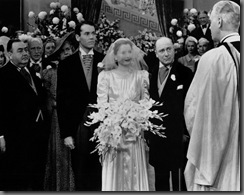
You’d think it would be more difficult to convince a man with whom you canoodled that you weren’t the same woman who tried to con him on the high seas.  In a way, I was a bit peeved at how easily I pushed my real identity out of Hopsie’s mind. Of course, this feeling was quickly usurped by an overriding disbelief that I once loved a man who could be fooled by a royal title, a British accent, and a small tiara.  It didn’t take long before I had Hopsie back under my spell, but what did I want to do with him?  What better punishment was there for a bachelor than marriage?  And, so, yes, I did it: I married my mark. Ah, but I wasn’t quite done with that idiot just yet. Grift Tip No. 6: Sell the game to the bitter end and then have a well-designed escape route. 

OEFM_The Lady Eve_lowWe opted to spend our wedding night on a train. I donned my best sheer negligee and eagerly awaited the entrance of Hopsie into my cozy compartment.  He was nervous—it was obvious this was his first ride on a train. I tried to calm him down by recounting other train rides I’d taken. Surely if men like Angus, Herman, Vernon, Cecil, John, Hubert…or was it Herbert…could enjoy a train ride with me, so could Hopsie!  Perhaps he was afraid of tunnels—I always found entering and exiting them to be exhilarating.  It was all just so odd! You’d think a man who liked to play with snakes wouldn’t be so frightened of a speeding train.  It was like being in one of those Preston Sturges’ films, except there was no sex.  Maybe I shouldn’t have told him about those other guys, because he got off the train at the first stop.

And, so there I was—married and abandoned in a day by an heir to millions.  Somehow I just didn’t feel like I had exacted enough revenge on old Hopsie. Grift Tip No. 8: If you can have your cake and eat it too, eat the entire thing.  Why should I settle for a piece of the Pike pie when I could have the whole thing? Yes, I know I have mixed my food metaphors, but they are both desserts and that’s what I was going to have: The-Lady-Eve-classic-movies-16677267-1067-800my just desserts! So, when the lawyers called about divorce proceedings I ignored them.  Knowing Hopsie to be a creature of habit I returned to the high seas armed with my pocket mirror, my long, shapely legs, and my real name.  It wasn’t too long before Hopsie was escorting Jean Harrington…um, Pike…to her cabin.  Yes, he was a bit shocked when I revealed to him that Jean and Eve were one in the same—but this time I waited until he got used to the motion of the ocean.  Grift Tip No. 7: There is no greater con game than love. 

2012 CiMBA- Best Film Review (Comedy-Musical) (1)(This post was honored with a 2012 CiMBA for Best Musical or Comedy Review.  Obviously, this was a comedy.)


Monday, July 5, 2010

Sergeant York (1941) **

sergeant_york

World War II had been going on for over two years when Sergeant York was released in the United States on September 27, 1941. The Germans had defeated my beloved French quite handily in the spring of 1940 and they had tried to obliterate the British throughout the fall of 1940. As this film entered American theatres the Russians were preparing themselves for a German push toward Moscow. And, in the Pacific, the Japanese had had enough of the US trade embargo that limited their access to petroleum and mineral ores—they decided to fully prepare for a war in the Pacific and began war games which would eventually lead to the event that transpired on December 7, 1941: Pearl Harbor. The United States, of course, was still a “neutral” country when this film came out, but it was becoming quite obvious that it was only a matter of time before they too would enter the fray.

Producer/director Howard Hawks had the perfect vehicle to submit to a traditionally isolationistic nation. Just like the hero of this film, York Alvin York (Gary Cooper), the United States was usually peace-loving. Yet, when the Germans went crazy in 1917 and sent the Zimmermann Telegram to Mexico and reengaged in unrestricted submarine warfare, America had to defend itself and its principles against tyranny. Thus, the nation entered WWI and the real-life Sgt. Alvin York had to become a Dough Boy and go “Over There”. Everyone knew in 1941 that we would be going “Over There” very soon, so why not make a picture that reminded Americans that sometimes you have to fight to ensure peace?

Nominated for eleven Academy Awards, including Best Picture, this film follows the exploits of a backwoods Tennessee farmer to the trench-filled Western Front. Alvin York is an ambitious young man who only wants to raise enough money to buy bottomland from Mr. Tomkins (Erville Alderson) and then marry sergeant-york-joan-leslie-gary-cooper-2 Gracie Williams (Joan Leslie). Given 60 days to come up with the necessary funds, York works himself like a dog. Yet, as time starts to run out he has to come up with some way to make fast money, and so he enters a turkey shoot hoping to win a prize steer. In a remarkable show of marksmanship, York wins the contest and raises the necessary money to buy his land. The problem is Mr. Tomkins has already sold the land. Feeling betrayed, York gets drunk and seeks revenge against those who stole “his” land. Riding out into a wild thunderstorm, York finds himself and his gun under assault by SergeantYork13-52-09-10 lightning bolts. One in particular hits his gun and knocks York off his horse. When he picks himself up off the ground he hears singing coming from the local church. When he stumbles into the church, Pastor Pile (Walter Brennan) and the congregation welcome York to his new Christian life. Believing Divine Intervention has stepped in the way of his committing murder, York become a Christian pacifist.

After turning over a new leaf, York finds his fortunes changing: he works out a sharecropping deal to buy the land he lost and Gracie sergeant_york_1941 agrees to marry him. But then the war in Europe steps in the way and York finds himself in a difficult situation. How can a Christian go to war when the Good Book is against killing? Even though York declares himself a conscientious objector, the Army still reluctantly wants him. Once the Army sees what York can do with a rifle they no longer have any reluctance at all. Yet, after having a discussion with York about what the Bible says about war, the camp commander, Major Buxton (Stanley Ridges), Annex%20-%20Cooper,%20Gary%20(Sergeant%20York)_03gives him a 2-week pass to reconsider his position. If he still wants out of the Army after his leave is up, the Major will allow it. On leave, York has another moment of Divine Intervention when the wind blows his Bible open to Matthew 22:21: ““Render unto Caesar the things which are Caesar’s, and unto God the things that are God’s”. Seeing this as a sign, York returns to the Army ready to serve his country.

In the trenches of France (specifically the Meuse-Argonne Offensive of 1918), York finds himself surrounded by death and 400px-SY_19 killing. Menacing machinegun fire just rips to shreds anything that peaks out of the trench or tries to cross the dreaded “No Man’s Land”. When York’s unit tries to flank a German machinegun nest, both the commanding officer and first sergeant are injured so severely that York must take command of the few men who are still alive in his unit. Virtually single-handedly York picks off the gunners by crawling around the machinegun nest. In the end, the few remaining German soldiers surrender to York. Behind enemy lines,York and his men work their way back to sergeant-yorkthe American position by taking unsuspecting German soldiers prisoners. Eventually German soldiers positioned on a ridge notice what is happening and start to fire on York and his men (and their prisoners nonetheless!). Again, York outsmarts his German adversaries (using a turkey call of all things) and they surrender to him. When York and his handful of men return to the American position, they have captured over 130 German soldiers.

His daring exploits are rewarded with the Medal of Honor and the Croix de Gurre. He is also sent back to the States to show Americans what a real hero looks like. When he returns to Tennessee he finds that the state has turned his undeveloped bottomland into a farm as a reward for his heroism.

sergeantyork1 Gary Cooper’s portrayal in this film earned him his first Academy Award. Playing a stereotypical country bumpkin with a very strong conscious, Cooper is at times a bit too earnest for my liking. However, very few men could play the reluctant hero as well as him. His scenes with Walter Brennan (who was nominated for Best Supporting Actor) where they discuss the Bible as it relates to the modern world are the most enjoyable to watch. It is interesting to note that the real Sergeant York handpicked Cooper for this role and served as an adviser on the film. When you read excerpts of his diary (which he kept while in the Army), it is not difficult to see why Cooper played him so humbly.

The battlefield scenes were expertly filmed and edited by Sal Polito and William Holmes respectively. Holmes won an Academy Award for his deft editing and Polito was nominated for his photography. When I was a middle school teacher I would show this film as an example of what warfare was like in WWI. The constant bombardment and never-ending trenches, with mangled barbed wire strewn everywhere, are something to behold. You combine these elements with a terrific Max Steiner score (another Oscar nominee), and you have, at times, a visually stunning film to watch.

This film could not have come out at a better time. It was a reminder of what war really looked like and how ordinary men could be compelled to do extraordinary things.